Monday, December 25, 2017

corrected


Weight Loss Article 4

The Supplement Conundrum

Is there a 'magic pill' for weight loss? Please say no. There are hundreds of claims, hundred of sales offers, and hundred of test results.  We must ask, how was the test carried out? Who paid for the test? One test was paid for by the company that sells a certain kind of fruit. What did their test reveal? Their fruit prevents cancer. When this test was conducted properly, the results showed no such benefit. It is easy to take a group and select the healthier ones to test the product on. Then, compare them to the other group. This is one way to lead the results. Don't trust every test, especially any quoted in a sales ad.

A proper scientific test should have a placebo group. A randomized controlled trial is A study design that randomly assigns participants into an experimental group or a control group.  Double blind means the testers don't know which group is which. Certain criteria must be followed. Did participants exercise 60 minutes a day or did the participants merely say they exercised? Having a participant simply check a box 'yes' or 'no' is not accurate enough. The other problem is that the test lasts just a few weeks or up to three months. This isn't long enough to gauge a loss that is gradual over one year. Yet, they are often pushed to get fast results.

My favorite example of positioning such a study is one that revealed salt is bad for you. Many quoted it and said, "Salt is bad for you. There's proof." Was it true? Were there health problems? Yes. Were they caused by salt with reliable results? No. Here's why. The group eating salt were people who ate a high salt diet consisting of hot dogs, pizza, potato chips, bacon,etc. They should have selected healthy individuals who lived on a healthy diet with high salt content to prove their point. They only proved that salty junk food is unhealthy.

Two views often exist side by side. To illustrate, an athlete sees his workout shirt has dried salt deposits. (Is it actually sodium chloride?) He immediately proclaims, "Look how much salt I've lost. I better replace it." A different athlete reacts, "Look how much salt I've lost. I must be eating too much. I better cut down my salt intake." Doctors who examine a controlled study will disagree as well. I had some points on Chromium picolinate based on one Doctor, but I changed my mind after doing more research. Dr. Jeukendrup agrees with a study of studies that show little to no effect on fat loss. Still, it was averaged at 1 pound of fat lost over the groups not taking chromium. That could add up to four pounds a year.. Onakpoya at Oxford. Some who touted chromium are now rather silent on the matter. Chromium supplements should be discussed with a doctor respecting any amount, especially diabetics. My interpretation of chromium in brief: High sugar diets will cause fat gain and chromium loss. Cutting out sugar will lead an active person toward weight loss. Chromium may help those individuals. Ask your doctor.

Getting the right nutrients might require only a change in diet. But, that is not always possible. While the body generally maintains the level of sodium chloride, potassium levels can get low. Should you run out and buy potassium then? If so, what kind and how many should one take? First, always calculate how much is actually needed. Second, how much are you getting?  Add the amount in your diet plus the amount in your one-a-day vitamin pill. What is the difference? 

Example: Potassium

  •              Recommended amount: 4700 mg (MNA)
  •              Dietary level (average): 2000-2500 mg
  •              Vitamin One-a-Day level: 0 
  •              Natural sources: Potato 900 mg, Banana 450, Kiwi (2) 430 , Spinach 420, Sweet Potato 540, Sport drink 37, Milk 382 (Ask me what I drink.)
  •              Regular table salt: zero
  •              Lite salt (Potassium Chloride) 1/4 teaspoon 600 mg
Supplement Dangers:Potassium
         
"Dangerous heart rhythm problems and even cardiac arrest" is possible in some cases. Use only with the guidance of a medical doctor. May have fatal effects with certain health conditions and/or medications. Extreme care is needed with diabetes, heart problems, high blood pressure, and various medications "such as spironolactone." Quote from Deepak Bhatt, MD Harvard Heart Letter June 2016. 

Vitamin D
There's good news respecting vitamin D3. More than one study shows what applies to almost all supplements. Vitamin D does not cause weight loss. Vitamin D deficiency may impair fat loss, especially in the stomach or belly area. What can we base this on? One study shows women lowered their fat with vitamin D. Another showed vitamin D lowered the amount of body fat. Keep in mind this vital point: the test subjects were given a healthy diet and exercised. The supplemented amount brought their vitamin D levels to where they should be.

Specifically, these studies used D3 oil gel caps. (not dry tablets). Natural vitamin D comes from sunlight. If you are outdoors with exposed skin you may get enough, and it's free. It is unlikely for many of us to get enough exposure especially in the winter. What about the vitamin D in my one-a-day vitamin pill, in my milk, and in my breakfast cereal? All I can suggest is that it is probably not the right type. How much money are corporations going to spend for this vitamin to be added to their product? Further, will D3 prove to be the next Chromium, touted one day and forgotten when the wind shifts to another supplement?

Recommendations from those test results are to take a high dosage for 90 days to overcome a deficiency, then supplement according to daily recommended levels. 4,000 iu was used as the highest level in testing. Don't go higher. By at least 10,000 iu, there is a strong toxicity danger. More is not better.

Here's what bothers me in advertising. This is a quote from a vitamin D ad where I will not mention the company. "Shed pounds fast"," No foods are off-limit". "Fat-melting" and "You'll lose weight quickly." This ad worries me. 

Consider using a supplement that will meet your requirements. Daily amount total is around 600 iu (Institute of Medicine 400-800). Studies show overweight individuals may require 1000-2400 iu. (1000 iu = 25 mcg) IOM Summary. A doctor can run a blood test. Just because you are D deficient does not guarantee that vitamin D supplements will cause weight loss. The jury is still out. Time will tell if the current studies are tried and true.

Dr. Soares says, "Overall, there is consistent evidence that calcium and vitamin D increase whole body fat oxidation." But added that there are not defined levels of the vitamin administered and the resulting change. So, it does work, as he sees it. But, it's unclear how much benefit it brings. (I say, for 10 dollars it seems good to try. For fifty dollars, I want solid proof.)

Dr. Pathak finds little evidence in eleven studies. However, he reports that none of the testers imposed a calorie restriction, nor was there any exercise protocol. One additional study did show a decrease in fat mass for women. Again, it does not state the full parameters. How much did exercise and diet come into play?

Caffeine and Green Tea
Caffeine seems to increase fat metabolism slightly. If it helps you ride harder for a longer time, then that's an added benefit. If you need an excuse to drink coffee, this is it: Dr. Graham. For me, I just love to drink it. If you are going to drink caffeine, do so before exercise. Then, wait for it to kick in.

Green tea has health benefits that may include fat metabolism. Catechins in green tea and decaf green tea may account for greater benefits than the caffeine in coffee. One study had a weight loss of 5.5 pounds in a three months versus 3 pounds for the group without tea. Definitive proof? No. It seems to be a fairly cheap approach though. I prefer to buy a good quality of loose leaf tea.

"Fat oxidation rates, during a 30-min cycling at 60% VO2max, were significantly higher (17%) following GTE ingestion compared to placebo." Dr. Jeukendrup concluded, "Green tea has the potential to increase fat metabolism at rest, also during exercise, and may help to lose body fat and body weight. As with caffeine, the effects appear to be relatively small." Dr, Jeukendrup's article.

Protein Powder
Whey Protein Concentrate is being haled as a weight loss aid. I much prefer egg white protein as it is very easy on my stomach. Does it reduce body fat in tests? It is difficult to say. Protein will benefit any weight training program. Is this protein in addition to a healthy diet? Is it a replacement for a meal protein like fried chicken or a cheeseburger? There's so many variables from one study to another. It quickly gets confusing. Every ad has an agenda, "Buy our product." Be careful with your health and your money. I take protein powder to get the right amount in my daily diet. The amount will differ from one person to another. It is based on muscle mass and the amount and type of daily exercise. I don't think protein will ever prove to change your fat metabolism. It may help you to eliminate saturated fats from your diet. That in itself, is a big step in the right direction.

Conclusion
There's no way to cheat the system of exercising and eating healthy. If you are sincerely cycling and lifting weights, you should gradually lose weight. Hopefully, Zwift enhances your exercise and increases your health. If something works for you, please share it with us at ZwiftOff. Join us for our group workouts as well.


Supplements


Weight Loss Article 4

The Supplement Conundrum

Is there a 'magic pill' for weight loss? Please say no. There are hundreds of claims, hundred of sales offers, and hundred of test results.  We must ask, how was the test carried out? Who paid for the test? One test was paid for by the company that sells a certain kind of fruit. What did their test reveal? Their fruit prevents cancer. When this test was conducted properly, the results showed no such benefit. It is easy to take a group and select the healthier ones to test the product on. Then, compare them to the other group. This is one way to lead the results. Don't trust every test, especially any quoted in a sales ad.

A proper scientific test should have a placebo group. A randomized controlled trial is A study design that randomly assigns participants into an experimental group or a control group.  Double blind means the testers don't know which group is which. Certain criteria must be followed. Did participants exercise 60 minutes a day or did the participants merely say they exercised? Having a participant simply check a box 'yes' or 'no' is not accurate enough. The other problem is that the test lasts just a few weeks or up to three months. This isn't long enough to gauge a loss that is gradual over one year. Yet, they are often pushed to get fast results.

My favorite example of positioning such a study is one that revealed salt is bad for you. Many quoted it and said, "Salt is bad for you. There's proof." Was it true? Were there health problems? Yes. Were they caused by salt with reliable results? No. Here's why. The group eating salt were people who ate a high salt diet consisting of hot dogs, pizza, potato chips, bacon,etc. They should have selected healthy individuals who lived on a healthy diet with high salt content to prove their point. They only proved that salty junk food is unhealthy.

Two views often exist side by side. To illustrate, an athlete sees his workout shirt has dried salt deposits. (Is it actually sodium chloride?) He immediately proclaims, "Look how much salt I've lost. I better replace it." A different athlete reacts, "Look how much salt I've lost. I must be eating too much. I better cut down my salt intake." Doctors who examine a controlled study will disagree as well. I had some points on Chromium picolinate based on one Doctor, but I changed my mind after doing more research. Dr. Jeukendrup agrees with a study of studies that show little to no effect on fat loss. Still, it was averaged at 1 pound of fat lost over the groups not taking chromium. That could add up to four pounds a year.. Onakpoya at Oxford. Some who touted chromium are now rather silent on the matter. Chromium supplements should be discussed with a doctor respecting any amount, especially diabetics. My interpretation of chromium in brief: High sugar diets will cause fat gain and chromium loss. Cutting out sugar will lead an active person toward weight loss. Chromium may help those individuals. Ask your doctor.

Getting the right nutrients might require only a change in diet. But, that is not always possible. While the body generally maintains the level of sodium chloride, potassium levels can get low. Should you run out and buy potassium then? If so, what kind and how many should one take? First, always calculate how much is actually needed. Second, how much are you getting?  Add the amount in your diet plus the amount in your one-a-day vitamin pill. What is the difference? 

Example: Potassium

  •              Recommended amount: 4700 mg (MNA)
  •              Dietary level (average): 2000-2500 mg
  •              Vitamin One-a-Day level: 0 
  •              Natural sources: Potato 900 mg, Banana 450, Kiwi (2) 430 , Spinach 420, Sweet Potato 540, Sport drink 37, Milk 382 (Ask me what I drink after a hard race.)
  •              Regular table salt: zero
  •              Lite salt (Potassium Chloride) 1/4 teaspoon 600 mg
Supplement Dangers:Potassium
         
"Dangerous heart rhythm problems and even cardiac arrest" is possible in some cases. Use only with the guidance of a medical doctor. May have fatal effects with certain health conditions and/or medications. Extreme care is needed with diabetes, heart problems, high blood pressure, and various medications "such as spironolactone." Quote from Deepak Bhatt, MD Harvard Heart Letter June 2016. 

Vitamin D
There's good news respecting vitamin D3. More than one study shows what applies to almost all supplements. Vitamin D does not cause weight loss. Vitamin D deficiency may impair fat loss, especially in the stomach or belly area. What can we base this on? One study shows women lowered their fat with vitamin D. Another showed vitamin D lowered the amount of body fat. Keep in mind this vital point: the test subjects were given a healthy diet and exercised. The supplemented amount brought their vitamin D levels to where they should be.

Specifically, these studies used D3 oil gel caps. (not dry tablets). Natural vitamin D comes from sunlight. If you are outdoors with exposed skin you may get enough, and it's free. It is unlikely for many of us to get enough exposure especially in the winter. What about the vitamin D in my one-a-day vitamin pill, in my milk, and in my breakfast cereal? All I can suggest is that it is probably not the right type. How much money are corporations going to spend for this vitamin to be added to their product? Further, will D3 prove to be the next Chromium, touted one day and forgotten when the wind shifts to another supplement?

Recommendations from those test results are to take a high dosage for 90 days to overcome a deficiency, then supplement according to daily recommended levels. 4,000 iu was used as the highest level in testing. Don't go higher. By at least 10,000 iu, there is a strong toxicity danger. More is not better. Here's what bothers me in advertising. This is a quote from a vitamin D ad where I will not mention the company. "Shed pounds fast"," No foods are off-limit". "Fat-melting" and "You'll lose weight quickly." This ad worries me.


Consider using a supplement that will meet your requirements. Daily amount total is around 600 iu (Institute of Medicine 400-800). Studies show overweight individuals may require 1000-2400 iu. (1000 iu = 25 mcg) IOM Summary. A doctor can run a blood test. Just because you are D deficient does not guarantee that vitamin D supplements will cause weight loss. The jury is still out. Time will tell if the current studies are tried and true.


Dr. Soares says, "Overall, there is consistent evidence that calcium and vitamin D increase whole body fat oxidation." But added that there are not defined levels of the vitamin administered and the resulting change. So, it does work, as he sees it. But, it's unclear how much benefit it brings. (I say, for 10 dollars it seems good to try. For fifty dollars, I want solid proof.)

Dr. Pathak finds little evidence in eleven studies. However, he reports that none of the testers imposed a calorie restriction, nor was there any exercise protocol. One additional study did show a decrease in fat mass for women. Again, it does not state the full parameters. How much did exercise and diet come into play?

Caffeine and Green Tea
Caffeine seems to increase fat metabolism slightly. If it helps you ride harder for a longer time, then that's an added benefit. If you need an excuse to drink coffee, this is it: Dr. Graham. For me, I just love to drink it. If you are going to drink caffeine, do so before exercise. Then, wait for it to kick in.

Green tea has health benefits that may include fat metabolism. Catechins in green tea and decaf green tea may account for greater benefits than the caffeine in coffee. One study had a weight loss of 5.5 pounds in a three months versus 3 pounds for the group without tea. Definitive proof? No. It seems to be a fairly cheap approach though. I prefer to buy a good quality of loose leaf tea.

"Fat oxidation rates, during a 30-min cycling at 60% VO2max, were significantly higher (17%) following GTE ingestion compared to placebo." Dr. Jeukendrup concluded, "Green tea has the potential to increase fat metabolism at rest, also during exercise, and may help to lose body fat and body weight. As with caffeine, the effects appear to be relatively small." Dr, Jeukendrup's article.

Protein Powder
Whey Protein Concentrate is being haled as a weight loss aid. I much prefer egg white protein as it is very easy on my stomach. Does it reduce body fat in tests? It is difficult to say. Protein will benefit any weight training program. Is this protein in addition to a healthy diet? Is it a replacement for a meal protein like fried chicken or a cheeseburger? There's so many variables from one study to another. It quickly gets confusing. Every ad has an agenda, "Buy our product." Be careful with your health and your money. I take protein powder to get the right amount in my daily diet. The amount will differ from one person to another. It is based on muscle mass and the amount and type of daily exercise. I don't think protein will ever prove to change your fat metabolism. It may help you to eliminate saturated fats from your diet. That in itself, is a big step in the right direction.

Conclusion
There's no way to cheat the system of exercising and eating healthy. If you are sincerely cycling and lifting weights, you should gradually lose weight. Hopefully, Zwift enhances your exercise and increases your health. If something works for you, please share it with us at ZwiftOff. Join us for our group workouts as well.


Saturday, December 23, 2017

Weight Loss Article 4


Weight Loss Article 4 
Supplements

Is there a 'magic pill' for weight loss? Please say no. There are hundreds of claims, hundred of sales offers, and hundred of test results.  We must ask, how was the test carried out? Who paid for the test? One test was paid for by the company that sells a certain kind of fruit. What did their test reveal? Their fruit prevents cancer. When this test was conducted properly, the results showed no such benefit. It is easy to take a group and select the healthier ones to test the product on. Then, compare them to the other group. This is one way to lead the results. Don't trust every test, especially any quoted in a sales ad.

A proper scientific test should have a placebo group. A randomized controlled trial is A study design that randomly assigns participants into an experimental group or a control group.  Double blind means the testers don't know which group is which. Certain criteria must be followed. Did participants exercise 60 minutes a day or did the participants merely say they exercised? Having a participant simply check a box 'yes' or 'no' is not accurate enough. The other problem is that the test lasts just a few weeks or up to three months. This isn't long enough to gauge a loss that is gradual over one year. Yet, they are often pushed to get fast results.

My favorite example of positioning such a study is one that revealed salt is bad for you. Many quoted it and said, "Salt is bad for you. There's proof." Was it true? Were there health problems? Yes. Were they caused by salt with reliable results? No. Here's why. The group eating salt were people who ate a high salt diet consisting of hot dogs, pizza, potato chips, bacon,etc. They should have selected healthy individuals who lived on a healthy diet with high salt content to prove their point. They only proved that salty junk food is unhealthy.

Two views often exist side by side. To illustrate, an athlete sees his workout shirt has dried salt deposits. (Is it actually sodium chloride?) He immediately proclaims, "Look how much salt I've lost. I better replace it." A different athlete reacts, "Look how much salt I've lost. I must be eating too much. I better cut down my salt intake." Doctors who examine a controlled study will disagree as well. I had some points on Chromium picolinate based on one Doctor, but I changed my mind after doing more research. Dr. Jeukendrup agrees with a study of studies that show little to no effect on fat loss. Still, it was averaged at 1 pound of fat lost over the groups not taking chromium. That could add up to four pounds a year.. Onakpoya at Oxford. Some who touted chromium are now rather silent on the matter. Chromium supplements should be discussed with a doctor respecting any amount, especially diabetics. My interpretation of chromium in brief: High sugar diets will cause fat gain and chromium loss. Cutting out sugar will lead an active person toward weight loss. Chromium may help those individuals. Ask your doctor.

Getting the right nutrients might require only a change in diet. But, that is not always possible. While the body generally maintains the level of sodium chloride, potassium levels can get low. Should you run out and buy potassium then? If so, what kind and how many should one take? First, always calculate how much is actually needed. Second, how much are you getting?  Add the amount in your diet plus the amount in your one-a-day vitamin pill. What is the difference? 

Example: Potassium

  •              Recommended amount: 4700 mg (MNA)
  •              Dietary level (average): 2000-2500 mg
  •              Vitamin level: 0 
  •              Natural sources: Potato 900 mg, Banana 450, Kiwi (2) 430 , Spinach 420, Sweet Potato 540, Sport drink 37, Milk 382 (Ask me what I drink after a hard race.)
  •              Regular table salt: zero
  •              Lite salt (Potassium Chloride) 1/4 teaspoon 600 mg
Supplement Dangers:Potassium
         
"Dangerous heart rhythm problems and even cardiac arrest" is possible in some cases. Use only with the guidance of a medical doctor. May have fatal effects with certain health conditions and/or medications. Extreme care is needed with diabetes, heart problems, high blood pressure, and various medications "such as spironolactone." Quote from Deepak Bhatt, MD Harvard Heart Letter June 2016. 

Vitamin D
There's good news respecting vitamin D (d3). More than one study shows what applies to almost all supplements. Vitamin D does not cause weight loss. Vitamin D deficiency may impair fat loss, especially in the stomach or belly area. What can we base this on? One study shows women lowered their fat with vitamin D. Another showed vitamin D lowered the amount of body fat. Keep in mind this vital point: the test subjects were given a healthy diet and exercised. The supplemented amount brought their vitamin D levels to where they should be. 
Specifically, these studies used D3 oil gel caps. (not dry tablets). Natural vitamin D comes from sunlight. If you are outdoors with exposed skin you may get enough, and it's free. It is unlikely for many of us to get enough exposure especially in the winter. What about the vitamin D in my one-a-day vitamin pill, in my milk, and in my breakfast cereal? All I can suggest is that it is probably not the right type. How much money are corporations going to spend for this vitamin to be added to their product? Further, will D3 prove to be the next Chromium, touted one day and forgotten when the wind shifts to another supplement?

Recommendations among doctors, take a high dosage for 90 days to overcome a deficiency, then supplement according to daily recommended levels. 4,000 iu was used as the highest level in testing. Don't go higher. By at least 10,000 iu, there is a strong toxicity danger. More is not better.

Here's what bothers me in advertising. This is a quote from a vitamin D ad where I will not mention the company. "Shed pounds fast"," No foods are off-limit". "Fat-melting" and "You'll lose weight quickly." This ad worries me. 

Consider using a supplement that will meet your requirements. Daily amount total is around 600 iu (Institute of Medicine 400-800). Studies show overweight individuals may require 1000-2400 iu. (1000 iu = 25 mcg) IOM Summary. A doctor can run a blood test. Just because you are D deficient does not guarantee that vitamin D supplements will cause weight loss. The jury is still out. Time will tell if the current studies are tried and true.

Dr. Soares says, "Overall, there is consistent evidence that calcium and vitamin D increase whole body fat oxidation." But added that there are not defined levels of the vitamin administered and the resulting change. So, it does work, as he sees it. But, it's unclear how much benefit it brings. (I say, for 10 dollars it seems good to try. For fifty dollars, I want solid proof.)

Dr. Pathak finds little evidence in eleven studies. However, he reports that none of the testers imposed a calorie restriction, nor was there any exercise protocol. One additional study did show a decrease in fat mass for women. Again, it does not state the full parameters. How much did exercise and diet come into play?

Caffeine and Green Tea
Caffeine seems to increase fat metabolism slightly. If it helps you ride harder for a longer time, then that's an added benefit. If you need an excuse to drink coffee, this is it: Dr. Graham. For me, I just love to drink it. If you are going to drink caffeine, do so before exercise. Then, wait for it to kick in.

Green tea has health benefits that may include fat metabolism. Catechins in green tea and decaf green tea may account for greater benefits than the caffeine in coffee. One study had a weight loss of 5.5 pounds in a three months versus 3 pounds for the group without tea. Definitive proof? No. It seems to be a fairly cheap approach though. I prefer to buy a good quality of loose leaf tea.

"Fat oxidation rates, during a 30-min cycling at 60% VO2max, were significantly higher (17%) following GTE ingestion compared to placebo." Dr. Jeukendrup concluded, "Green tea has the potential to increase fat metabolism at rest, also during exercise, and may help to lose body fat and body weight. As with caffeine, the effects appear to be relatively small." Dr, Jeukendrup's article.  


Protein Powder
Whey Protein Concentrate is being haled as a weight loss aid. I much prefer egg white protein as it is very easy on my stomach. Does it reduce body fat in tests? It is difficult to say. Protein will benefit any weight training program. Is this protein in addition to a healthy diet? Is it a replacement for a meal protein like fried chicken or a cheeseburger? There's so many variables from one study to another. It quickly gets confusing. Every ad has an agenda, "Buy our product." Be careful with your health and your money. I take protein powder to get the right amount in my daily diet. The amount will differ from one person to another. It is based on muscle mass and the amount and type of daily exercise. I don't think protein will ever prove to change your fat metabolism. It may help you to eliminate saturated fats from your diet. That in itself, is a big step in the right direction.

Conclusion
There's no way to cheat the system of exercising and eating healthy. If you are sincerely cycling and lifting weights, you should gradually lose weight. Hopefully, Zwift enhances your exercise and increases your health. If something works for you, please share it with us at ZwiftOff. Join us for our group workouts as well.


Friday, December 15, 2017

Article 3


Exercise for Weight Loss Article 3

Exercise:

Muscles are where fat is burned. Muscle is the engine. The goal here is two-fold. First, we are doing Zwift indoor cycling as part of our effort to burn fat. Outdoor riding and especially hill climbs are wonderful for this goal. We need specific efforts in indoor cycling to target fat burning. We need gears and a cadence that will incorporate our strength. The second aspect is retaining and increasing muscle mass. Aerobic exercise by itself will not build the strength we want. Strength exercise, like weight lifting, prevents the body from stealing unused muscle tissue for energy, protein, and nutrients. Don't confuse thin with fit. If weight loss is mostly muscle loss rather than fat, losing fat will become more difficult.

The body does not like to burn fat. It requires more energy to convert fat into usable fuel than it does to burn simple sugars. To encourage the process of using stored body fat for fuel, we want to exercise early in the morning before eating. Our body should be using fat while we sleep and, in a true sense, we are fasting for those eight to twelve hours. This process will continue by lifting weights, cycling, and jogging. As soon as you increase your cycling or running to a high aerobic effort, you start to burn more calories than your body can provide by converting fat into fuel.

Eating right before exercise will only tell your body to burn those calories instead of using stored fat. There is a totally different approach for athletes before an intense race. Morning workouts will raise your metabolism for up to eighteen hours. Having more muscle through strength training will keep your resting metabolic rate higher too (or RMR).

Sprinting and anaerobic efforts kick your body into burning its supply of muscle glycogen. On the other hand, long endurance training can cause muscle loss. Your body may break down muscle tissue in your arms, back or chest to provide protein, energy, and nutrients to your body. This is why we need to keep calories, nutrients, and protein at the proper levels while reducing fat intake. Marathon runners and many Ironman competitors are training on the edge of what is possible. The risk of long endurance exercise includes over training, being under nourished, and suffering muscle deterioration. They may look ultra lean, but often they suffer hormone deficiencies, iron depletion, and training injuries. Leave that to the pros.

Strength training the whole body raises muscle mass. Additionally, it raises hormone levels. With sprinters, the muscle cells in their arms, shoulders, and chest store more fuel (as in carb loading) and provide more energy when needed. This is why a sprinter who uses weight training for only the leg muscles will not become a world champion. A well known sprinter is Usain Bolt. Look at his upper body muscle structure.

Weight training is necessary. You might only be able to go once a week and lift. If so, work your entire body. I prefer to go twice a week and do half my body each time. Best scenario is to do some type of weights daily, even just a few minutes with a pair of light dumbbells. Personal trainers are in the best position to access your needs. Always stick to good form, perfect form. Don't compromise form in order to lift more weights. Do the down movement slowly, eccentric movement. It is the hardest to do in a gym with other people because most don't set a good example.


Sprinters benefit when they train their entire muscle system.
Marathoners often suffer with deficient muscle mass.


Make a Schedule:

The best scenario for power cycling is sixty minutes of low intensity exercise each and every day. A good level might be something as 3 days of 45 minutes, 2 days of 20 minutes, and one day of 90 minutes, with one day open. The minimum amount of exercise is four sessions of 30 minutes each.

Make a Routine:

After getting up early a few days in a row, you will want a day to sleep in. You can skip the bike, get up late, make some coffee. But, then go for a walk outside or do 20 minutes of other exercise, such as the foundation exercise linked below. Don't let yourself get lazy. That's not an option.

If you wake up five minutes before your alarm goes off, that's a bonus. It may seem hard to do all of this regularly. It will become much easier when it becomes an ingrained habit. Many sources say it takes three to five weeks of steady behavior before our body and mind reprograms. Until then, it may fight you from time to time. Expect a setback or two, a temporary weight gain, a lack of motivation, or some other diversion. It will get easier when your program becomes a habit, the normal routine.

Preparation will help your new routine. Before going to bed, lay out your clothing for the morning. Set up the coffee maker, pack your lunch for work. Take a minute and oil your chain. Check the tire pressure. Above all, make sure you get enough sleep, at least eight hours.

Drink Plenty of Water:

Dehydration will not only hamper performance. It will hinder fat burning as well. I use filtered water with a splash of lime juice. I find I drink slightly more that way. A few more thoughts are in the article Hydration for Zwifters. During your workout, breath deeply to give your body the oxygen it needs to burn fat.

Variety is the Spice:

Keep it fresh. Change your weight routine without trying to add five pounds every workout. Find some new music on Pandora or YouTube. Enter a race, try a group ride, or do a different type of workout. Only did 3 of 6 sections? So what? Next time try to do 4. The improvement is more important than the success.

On the Bike:

You might want to ride a straight 45 to 60 minutes every day in a gear that puts your cadence under 80 rpms. Intervals break up the monotony of long segments. Please, don't use a huge gear that will make your knees ache. Everyone is different. I am giving general directions but I can not function as a personal trainer in absence. All advice has to be tailored to your level of fitness and ability. It is safest to consult a professional that will help you individually.

Here is an example of a low cadence workout: whatsonzwift.com/
Note the effort is in the blue zone. This is a fairly easy ride. You might want to skip the yellow and red sections. Green is medium, yellow is a bit harder. Orange is hard and red is very hard. Remember, the high levels are burning very little fat. If you are gasping for air, then your body has to burn glycogen, sugars, and carbs. 

Another example: whatsonzwift.com/

Note this is a very long workout. It does use the blue and green zones well. Don't forget, when you use a workout like this, you can skip ahead by hitting the tab button. Use it to shorten your warm-up or finish early.  I left the Zwift ad in there on purpose. 


Core Training, Foundation Work, and Weight Training:

I have found these videos to be of great benefit personally. There are many other programs and routines available. Check the source and their credentials. As stated everywhere: "Check with your Doctor especially regarding any health conditions you may have."

I have been taught through the Colgan Institute and reflect a lot of that in my training, diet, and advice. I am always learning more on nutrition and diet.


Foundation Starting Video

Foundation Training Daily Routine

Prone Decompression

MTSLA Playlist

Thursday, December 14, 2017

B Group Win KISS Crit series.

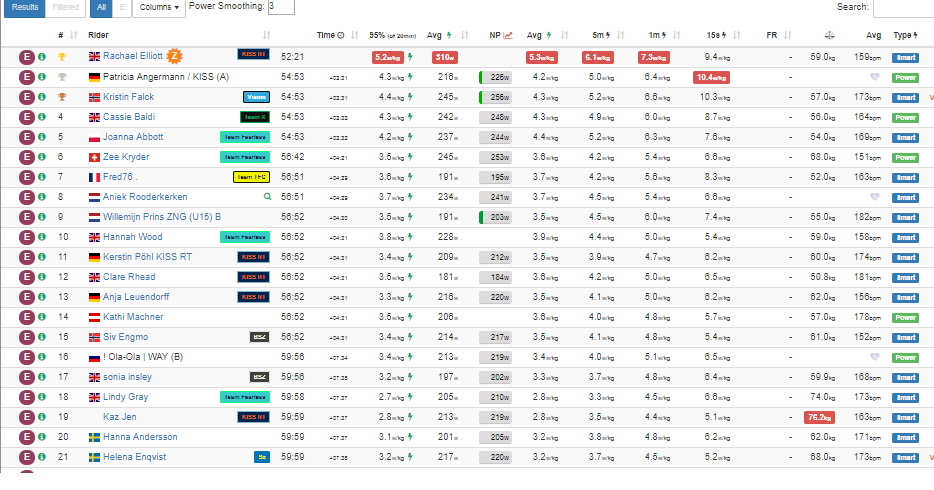
After feeling terrible and tanking the race last week, this was my best performance. I took 6th place. I was in a group of 10 most of the entire race. On the last lap, there was a rider in front of the pack doing almost 4 w/kg to our 3.5 to 3.7. Nobody was catching her. She went from 12 seconds to 8 and it just hung there for half of the lap. I don't know why, but I decided to sprint off after her. I caught her before the bottom of the climb on the Classique. She was with me for a minute or so. But half way up the hill, she stuttered. I couldn't afford to let the pack catch back up, so I kept going fairly hard. At he 1 k kite, I was up 8 seconds. I never believe it, prob about 4 seconds. I tried to sprint at 700 to go. With no one making ground, I coasted the last 200 or so. I felt so good, i kept on for the full hour ride. 243 for the hour is a new pr for me.


Tuesday, December 12, 2017

WBR 10 Km B Fiirst (4th overall) Decent Race


It wasn't a very tough start. Just a little soft for a one lap. Past the half, 3 riders got together at the front. They started to give up around the Sprint Bridge. we caught them and I stayed up front on the Esses climb. It was a little tough keeping up through those rises. I didn't have an aero, just a feather. Used it to gain a bit of speed. Jumped early and didn't carry it all the way to the line. wound up in 5th (behind a Z power who put C down)

So, got first in B cat. Felt really good after. It would help if A cat put A in their name. I just race for the win A or B.

Love this race. Can't wait to do it again!